support@registrationkraft.com




In a company, there are several executives who work together to ensure that company carries out its operations smoothly. One of the most important and senior executive positions in a company is undeniably that of Managing Director (MD). The role of an MD in any company is crucial.
They are responsible for guiding business towards its long term goals. At the same time, they’re also responsible for ensuring that its day-to-day operations take place in a smooth manner. Simply put, the Managing Director plays quite an important role when it comes to leading company and ensuring that its business objectives are achieved.
Who is a Managing Director in a Company?
A Managing Director (MD) is one of the top level executives in a company. They are mainly responsible for managing company’s day-to-day business activities and making sure that company’s plans are properly implemented. The MD may look after different departments, manage resources, guide employees and ensure that business runs smoothly. They also help turn decisions and strategies made by Board of Directors into actual results.
In many companies, the role of an MD and a CEO can be similar. Sometimes, same person may hold both positions. However, in larger companies, the MD may report to CEO or manage a particular business unit. In simple words, an MD is a senior leader who helps run the company and makes sure its business operations work properly.
Key Performance Indicators (KPIs) for MDs
If you want to understand how effectively a Managing Director is leading company, you can measure their performance through different KPIs. Some of most common KPIs include the following:-
- Financial Performance Metrics:- The commonly used indicators to know whether the MD is driving profitability and ensuring sustainable business growth include revenue growth, profit margins and return on investment.
- Operational Excellence:- KPIs like process efficiency, quality control and customer satisfaction can show how smoothly the company is operating and whether it is consistently delivering value or not. The MD plays an important role in ensuring that all these areas are properly managed.
- Leadership and Team Management:- To understand how well an MD builds and maintains a motivated and skilled workforce within the company, some important KPIs can be considered. These include employee engagement, retention rates and the leadership development efforts taken up by the MD from their end.
- Innovation and Adaptability:- If you want to see how effectively an MD is responding to evolving market demands, some important metrics to look at include new product launches, the amount invested in research and development and how well the MD manages change within the company.
- Strategic Planning and Execution:- How effectively an MD is leading the company’s growth can be understood through strategic planning as well as the execution.
Roles and Responsibilities of Managing Director
Every employee plays an important role in the success of a company. However, becoming a Managing Director is a major responsibility that usually requires years of hard work, experience and strong leadership skills.
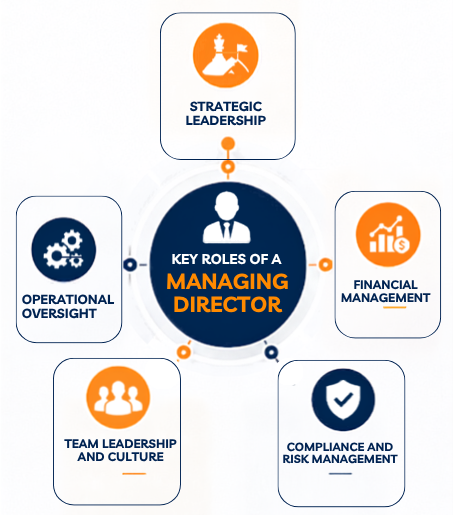
A Managing Director is entrusted with several important roles and responsibilities by the company and plays a key role in managing its overall operations. Below, we have discussed the main roles and responsibilities of a Managing Director.
Strategic Leadership
A Managing Director is one of the main people responsible for deciding the direction in which a company should move. They analyse market trends and identify areas where the company can find new growth opportunities. They also work to ensure that the company remains competitive in the market.
Operational Oversight
Everyone knows that having a clear vision is important for a company. Without a proper vision and direction, a company can lose its momentum and may struggle a lot to grow. That is why a Managing Director needs to have a strong vision, especially considering the important role they play in company. However, merely having a vision is not enough. An MD also needs to ensure that the day-to-day operations of business run smoothly.
Hardworking and effective MDs work closely with different departments within the company to manage resources, streamline workflows and improve overall efficiency of business. The way an MD leads in these areas can directly impact employee performance, workplace culture and long term sustainability of company’s operations.
Financial Management
Another very big responsibility bestowed upon an MD is protecting and maintaining the company’s financial health. For this, the MD oversees budgeting, works on forecasting and monitors profitability. At the same time, they also keep a close eye on cost management and risks.
The MD collaborates with finance team so as to ensure the company complies with legal requirements, maintains fiscal discipline and makes decisions that support the company’s sustainable growth and long term stability.
Team Leadership and Culture
A successful MD is one who knows the immense value of building a strong internal culture. They lead by example and keep the executive team fully motivated. They take responsibility for recruiting key talent because, after all, a company can only grow with the help of the right talent.
But an MD has much more to do than just hiring people. They develop systems and practices within the company that promote the principle of collaboration. This helps them create a high-performance workplace where every employee feels that they also have value within the company.
Compliance and Risk Management
Along with all the other roles and responsibilities, an MD also ensures that the company operates in a legally compliant manner and follows all regulatory requirements and industry standards.
They introduce policies within the company to minimise risks while also protecting the company’s image. This role of MD not only safeguards the present operations of the business but also protects its long-term credibility.
Conclusion
Calling a Managing Director simply a senior employee does not do justice to their role in a company. Their role is much deeper and it requires vision, discipline, leadership and adaptability. They take complete care of the company’s financial health and are also responsible for the kind of culture employees experience within the company. They maintain the trust of stakeholders. So, because of all these things, it can be said that an MD is truly at the heart of a company’s success. When their leadership is executed in the right way, it not only leads to business growth but also brings long term stability to the company.
Similar Post:- How to Become a CEO of Company
Frequently Asked Questions (FAQs)
Q1. Is a Managing Director the same as a CEO?
No. In some companies, the roles of MD and CEO may overlap. In other companies, these roles are completely separate. An MD generally focuses more on managing day-to-day operations and ensuring that business plans as well as strategies are properly implemented. On the other hand, a CEO usually has a broader leadership role and may focus more on overall direction and external representation of company.
Q2. What qualifications are needed to become a Managing Director?
There is no fixed path to becoming an MD like there is for becoming a doctor or a lawyer. You cannot simply give an entrance exam, get a degree and become an MD. However, many MDs are highly educated and intellectual individuals who often have advanced degrees related to business, finance or management. Along with education, an MD is usually highly experienced in sector in which they become a leader.
Q3. How does an MD impact company culture?
The MD plays an important leadership role in the company. They set the tone for the workplace by leading through example. The way they make decisions and interact with employees can directly affect company culture and employee morale.
Q4. Do MDs interact directly with customers?
In a general scenario, MDs do not interact directly with customers unless there is a major issue or an important situation demanding their attention. The responsibility of direct interaction is usually handled by client relationship managers, customer executives, sales consultants and other relevant teams. However, in smaller companies or startups or during important negotiations, an MD may personally engage with clients or business partners.
Q5. What is the biggest challenge faced by a Managing Director?
Perhaps the biggest challenge faced by a Managing Director is finding a balance between company’s short term operational needs and its long term strategic goals. They are expected to deliver results as quickly as possible, which often creates a lot of work pressure for them. At the same time, it is also part of their job to ensure that the business remains competitive and prepared for the future.
Q6. Is Managing Director higher than CEO?
No. Usually, the CEO’s position is higher than an MD. Therefore, the MD usually reports to the CEO.