support@registrationkraft.com


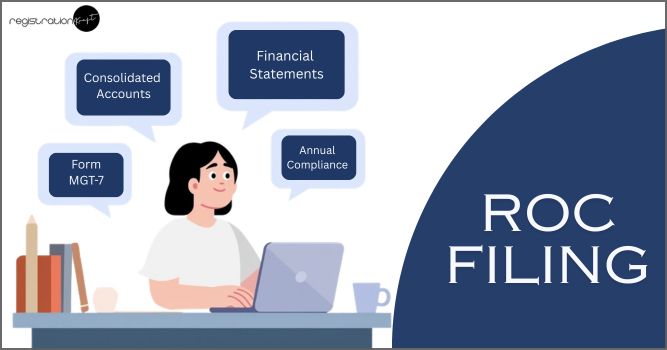

ROC full form is Registrar of Companies. It is a government authority operating under the Ministry of Corporate Affairs, which is one of the union government ministries in India. The ROC is majorly responsible for regulating and maintaining records of the registered companies in the country. Whenever a company is incorporated or files documents pertaining to compliance, reporting or statutory requirements via MCA portal, those documents are ultimately submitted to the ROC for review as well as record-keeping purposes.
Companies are also required to notify the ROC whenever an important change in the business takes place like appointment/resignation of directors, increase in share capital, change in company name/registered office address or other crucial corporate events that take place using the prescribed forms. These submissions are known as ROC filings.
Simply put, ROC filing is the process wherein the company-related documents, returns and information are submitted to ROC as required under the Companies Act, 2013, and rules made thereunder. ROC filing for companies helps to ensure legal and regulatory compliance and keeps the business records updated with the government.
List of Forms Required for ROC Filing
The following forms are some of the most common forms used for ROC filing:-
| Form | Purpose | Filing Type |
| AOC-4 | Financial Statements | ROC Annual Filing |
| AOC-4 CFS | Consolidated Accounts | ROC Annual Filing |
| MGT-7 | Annual Return | ROC Annual Filing |
| MGT-7A | OPC Annual Return | Filed on an Annual Basis |
| ADT-1 | Auditor Appointment | Event-Based Filing |
| ADT-3 | Auditor Resignation | Event-Based Filing |
| DIR-12 | Director Changes | Event-Based Filing |
| INC-20A | Business Commencement | One-Time Filing |
| INC-22 | Registered Office Change | Event-Based |
| INC-6 | OPC Conversion into Public/Pvt Ltd or Vice Versa | Event-Based |
| MGT-14 | Resolution Filing | Event-Based |
| PAS-3 | Share Allotment | Event-Based |
| SH-7 | Capital Alteration | Event-Based |
| CHG-1 | Charge Creation | Event-Based |
| STK-2 | Company Strike Off | One-Time |
| MR-1 | Managing Director / Whole Time Director Appointment | Event-Based |
Dire Consequences of Failure to File ROC Forms
If a company does not file ROC forms on time, it can face serious problems under the Companies Act, 2013. For example, if Form AOC-4 (financial statements) is not filed within the due date after the AGM, the company has to pay a late fee of Rs. 100 per day.
If the delay continues further, the penalties become even higher. The directors can also be disqualified. In serious cases, legal action can be taken. In the worst scenario, the company can even be removed/struck off by ROC. Therefore, it is best to complete ROC filings on time to avoid penalties and legal consequences.
ROC Filing Consultant
ROC filing can sometimes feel like a pile of never-ending paperwork if you try to handle it all on your own. The forms, documents and compliance rules can seem extremely daunting and confusing, especially if you are not exactly used to dealing with company filings. Quickly, it can quickly turn into a head-scratching task that eats up all your precious time and energy, which you could’ve otherwise spent on growing your business.
That is why many businesses choose to work with a ROC filing consultant. A good consultant can turn the whole process into a smooth one by handling all the paperwork, gathering details and making sure everything is filed well on time without last-minute stress.
For more than a decade, Registrationwala has been one of the most trusted consultants in India, especially for the ROC filing services. We help businesses stay compliant without the stress, mess or deadline drama.
Frequently Asked Questions (FAQs)
Q1. What is the late fee for ROC?
It totally depends on the ROC form you’ve failed to file in a timely manner.
Q2. What exactly is ROC filing?
It is the process wherein a company files necessary forms, financial statements and other documents, as deemed necessary, with ROC so as to ensure compliance with legal and regulatory requirements.
Q3. What happens if a company fails to file ROC returns in a timely manner?
The company has to pay late fees and penalties in case of failure to file ROC returns in a timely manner. Continued default can lead to higher penalties, disqualification of directors and even strike-off of the company by the ROC.