support@registrationkraft.com


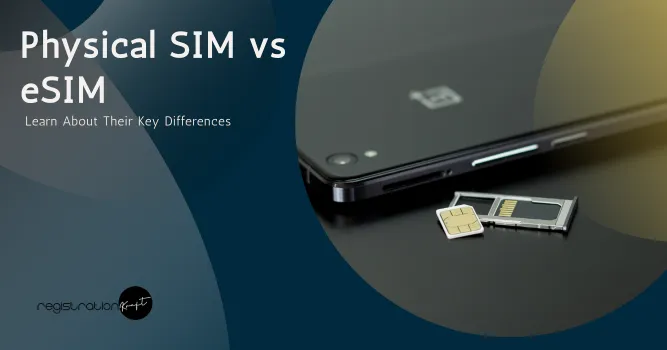

SIM stands for Subscriber Identity Module. It is a smart card or chip that stores data for authenticating your identity on a mobile network. There are two types of SIM cards, namely, Physical SIM and eSIM.
The eSIM is a newer, digital technology while the physical SIM is the traditional plastic card used in most mobile devices. In this blog post, we shall discuss the differences between them.
What is Physical SIM?
A physical Subscriber Identity Module (SIM) refers to the traditional, removable small plastic chip or card that is inserted into a mobile phone’s slot to connect to a cellular network. This card stores network identification data to enable calls, texts and data. A small metal SIM ejector tool is required to open the SIM card tray so the physical-SIM can be inserted.
This SIM card can be easily swapped between phones. Although its modern version ‘eSIM’ is available, the traditional physical card continues to be more popular.
What is eSIM?
eSIM means embedded SIM. It is a modern, digital, programmable chip that is soldered directly onto the motherboard of a device. Like physical SIM, eSIM also serves the purpose of connecting the mobile phone to a cellular network.
However, eSIM offers greater convenience and flexibility as it allows you to activate a plan directly from mobile settings, without requiring to swap the physical cards.
Difference Between Physical SIM and eSIM
The difference between Physical SIM and eSIM can be understood with the help of the table below:-
| Aspect | Physical SIM | eSIM |
| Definition | It is a traditional, removable small plastic chip/card inserted into a mobile device’s slot to connect to a cellular network. | eSIM (embedded SIM) refers to a digital, programmable chip soldered directly onto the motherboard of a mobile phone to connect to a cellular network without a physical plastic SIM card. |
| Convenience | It is less convenient than eSIM. It requires physical handling and manual installation. | It is more convenient than physical SIMs. It does away with the need for swapping physical cards. |
| Installation | This SIM requires physical insertion. | This SIM requires digital activation. |
| Security Level | It is less secure than an eSIM. It can be stolen or lost. | It is much more secure than physical, traditional SIMs. It cannot be stolen or encrypted. |
| Year of Launch | It was invented in 1991 by German smart-card manufacturer Giesecke+Devrient (G&D). | The concept of eSIM was first introduced by the Global System for Mobile Communications Association (GSMA) in 2010. |
Conclusion
SIM cards are indispensable for cellular network connection. They were first introduced to the world in 1991 by a Munich-based smart-card manufacturer. The SIM cards can be removable (physical SIMs) or embedded (eSIMs). They authenticate, identify and securely connect devices to mobile networks for calls, SMS and data services. Generally, eSIMs are considered to be more secure than physical ones as they cannot be stolen or encrypted. However, the physical SIMs still continue to be more popular.
Frequently Asked Questions (FAQs)
Q1. When were SIM cards introduced in India?
SIM cards were introduced in India in 1995.
Q2. Who invented the SIM card?
The first SIM card was invented by German smart-card manufacturer Giesecke+Devrient (G&D) in 1991.
Q3. What is eSIM?
eSIM, or embedded SIM, is a digital, programmable chip. It is embedded directly into a phone device to connect to a cellular network.
Q4. Are eSIMs more secure than physical SIMs?
An eSIM is embedded into the device directly. It is a non-removable chip. It cannot be stolen or encrypted, making it more secure than the physical SIMs.
Q5. Can eSIM be physically removed?
No, it cannot be physically removed. It is soldered directly onto the device’s motherboard.
Q6. Can eSIMs be used in smartwatches?
Yes, the eSIMs can be used in compatible smartwatches.