support@registrationkraft.com


What is PM-RAHAT Scheme
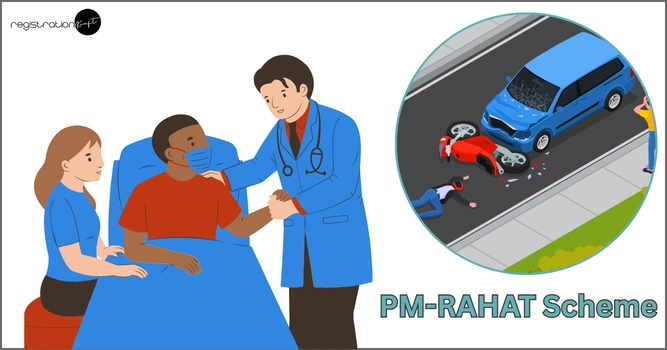

Road accidents are one of the biggest public safety concerns in India. Every year, thousands of people lose their lives or suffer serious injuries because they do not receive medical treatment on time. To address this issue, the Government of India launched an important initiative known as the Prime Minister – Road Accident Victims’ Hospitalisation and Assured Treatment (PM-RAHAT) Scheme.
This scheme ensures that road accident victims receive immediate and cashless medical treatment, especially during the critical Golden Hour after an accident.
In this blog post, we will explain what the PM-RAHAT Scheme is, its benefits, how it works, and why it is important for road accident victims in India.
Introduction to the PM-RAHAT Scheme
The PM-RAHAT Scheme has been introduced in accordance with the legal requirement under Section 162 of the Motor Vehicles Act, 1988. The scheme was officially notified through S.O. 2015(E) dated 05.05.2025, and detailed implementation guidelines were issued later through S.O. 2489(E) dated 04.06.2025.
The scheme was launched by the Prime Minister on 13 February 2026 and formally named the Prime Minister – Road Accident Victims’ Hospitalisation and Assured Treatment (PM-RAHAT) Scheme through S.O. 952(E) dated 19.02.2026.
The primary goal of the scheme is to ensure timely and uninterrupted medical care for road accident victims, particularly during the Golden Hour, which is the most critical period immediately after an accident.
Key Benefits of the PM-RAHAT Scheme
The PM-RAHAT Scheme provides several important benefits to road accident victims across India.
1. Cashless Treatment up to ₹1.5 Lakh
Under this scheme, road accident victims can receive cashless medical treatment up to ₹1.5 lakh.
- The treatment cover is available for a maximum period of 7 days from the date of the accident.
- It applies to accidents occurring on any type of road.
- The scheme covers all victims involved in road accidents caused by motor vehicles.
This financial support ensures that victims receive treatment without worrying about immediate medical expenses.
2. Immediate Stabilization Treatment
The scheme ensures that accident victims receive initial stabilization treatment at designated hospitals.
- Up to 24 hours of stabilization treatment for non-life-threatening cases
- Up to 48 hours of stabilization treatment for life-threatening cases
This treatment is provided subject to police response and verification, ensuring that victims receive medical attention quickly.
3. Priority Over Other Government Schemes
The PM-RAHAT Scheme takes precedence over any other Central or State government schemes related to road accident treatment. This ensures that there is no delay or confusion in providing medical assistance to accident victims.
Digital Implementation of the Scheme
One of the most important aspects of the PM-RAHAT Scheme is its fully digital implementation system, which ensures transparency and efficiency.
The scheme has been implemented by integrating two major digital platforms:
- eDAR (Electronic Detailed Accident Report)
- Used by police officials to report road accidents.
- TMS 2.0 (Transaction Management System)
- Managed by the National Health Authority (NHA).
- Used by hospitals for treatment records, claim submissions, and payment processing.
This integration ensures a complete digital trail from the time an accident occurs until the hospital receives payment.
How the PM-RAHAT Scheme Works
The process under the PM-RAHAT Scheme is designed to ensure quick medical response and smooth coordination between different authorities.
Step 1: Accident Reporting
The accident can be reported through the 112 Emergency Response Support System (ERSS).
Victims or Good Samaritans (RAH-VEER) can:
- Get information about the nearest designated hospital
- Request an ambulance
- Receive emergency assistance immediately
Step 2: Hospital Admission and Treatment
Once the victim is admitted to a designated hospital, the treatment process begins immediately.
Hospitals provide treatment according to Health Benefit Packages developed by the National Health Authority (NHA).
Step 3: Police Authentication
While treatment is ongoing:
- The police initiate authentication of the victim on the TMS platform.
- Hospitals generate Treatment ID(s) on TMS.
- These IDs are sent to district police through the eDAR system.
The police must respond within:
- 24 hours for normal cases
- 48 hours for life-threatening cases
Step 4: Claim Processing and Payment
Hospitals submit treatment claims through the TMS platform.
Payments are made from the Motor Vehicle Accident Fund (MVAF).
The MVAF is funded through:
- Contributions from general insurance companies when the offending vehicle is insured
- Government budgetary support for uninsured vehicles and Hit-and-Run cases
Once a claim is approved by the State Health Agency (SHA), payments must be made within 10 days by the District Collector or the General Insurance Council.
Hospitals Covered Under the PM-RAHAT Scheme
To ensure sufficient treatment facilities, the National Health Authority (NHA) has issued guidelines for the designation and onboarding of hospitals across states and union territories.
Hospitals eligible under the scheme include:
- Designated hospitals approved by the government
- Hospitals empanelled under Ayushman Bharat – Pradhan Mantri Jan Arogya Yojana (AB PM-JAY) that comply with scheme guidelines.
As of 9 March 2026, there are 36,112 hospitals empanelled under the Ayushman Bharat PM-JAY scheme, many of which can provide treatment under the PM-RAHAT Scheme.
Transparency and Digital Monitoring
The scheme includes an end-to-end digital workflow that links accident reports with treatment records.
This system ensures:
- Transparency in claim processing
- Prevention of misuse or fraud
- Faster payments to hospitals
- Accurate accident and treatment records
Grievance Redressal Mechanism
The PM-RAHAT Scheme also includes a structured grievance redressal system to resolve issues faced by victims, hospitals, or other stakeholders.
District Level
- District Road Safety Committees (DRSCs) monitor the scheme implementation.
- A Grievance Redressal Officer (GRO) is appointed to handle complaints.
State Level
If issues are not resolved at the district level, they can be escalated to:
- District Collector
- State Road Safety Council (SRSC)
The SRSC acts as the nodal agency for implementing the scheme in each State or Union Territory.
National Level
At the national level, an Inter-Ministerial Steering Committee supervises the overall implementation and reviews issues related to the scheme.
Objective of the PM-RAHAT Scheme
The PM-RAHAT Scheme has been designed to fulfill the statutory mandate under the Motor Vehicles Act, 1988, with the main objective of:
- Ensuring timely medical care for road accident victims
- Providing cashless emergency treatment
- Saving lives during the Golden Hour
- Improving coordination between hospitals, police, and emergency services
By removing financial barriers and ensuring immediate treatment, the scheme aims to significantly reduce fatalities caused by delayed medical care after road accidents.
Conclusion
The PM-RAHAT Scheme is a major step by the Government of India to improve emergency medical care for road accident victims. With cashless treatment up to ₹1.5 lakh, digital monitoring, integration with emergency services, and a strong grievance redressal system, the scheme ensures that accident victims receive timely treatment without financial stress.
By focusing on quick response during the Golden Hour, the PM-RAHAT Scheme has the potential to save thousands of lives every year and strengthen India’s road safety ecosystem.
This information was shared by the Union Minister for Road Transport and Highways, Shri Nitin Jairam Gadkari, in a written reply in the Rajya Sabha.


Categories: Gov Yojana
Tags:
Related Post