
 support@registrationkraft.com




Cooperative banks are a cornerstone of India’s financial system, especially when it comes to empowering farmers and bringing financial services to every corner of the country. But what exactly are cooperative banks, and why are they so important? In this guide, we’ll explore their structure, the different types, and how they operate. We’ll also break down the regulatory framework that keeps them running smoothly, making it easier to understand the vital role they play in building a more inclusive and supportive economy.
What is a Cooperative Bank?
Imagine a bank that’s run by the very people who use its services, working together to help each other grow. That’s the heart of a cooperative bank. These banks operate on the principles of mutual support and community benefit, making them quite different from profit-driven commercial banks. Their main goal isn’t to earn big profits but to offer affordable financial services to their members, whether they’re small business owners, farmers, or individuals in urban and rural areas.
Cooperative banking institutions stand out because they are owned and managed by their members. As a member, you’re not just a customer—you’re a part-owner with a say in how the bank operates. Governed by the Banking Regulations Act of 1949 and the Banking Laws (Co-operative Societies) Act of 1955, these banks follow a simple motto: “no profit, no loss.” This means they prioritize the needs of their community over maximizing revenue, fostering a genuine sense of trust, accountability, and local empowerment.
If you’ve ever wondered what makes these banks special, it’s this people-first approach—helping communities thrive, one member at a time.
Current Landscape of Co-operative Banks in India
India is home to 1000s of co-operative banks, each serving diverse needs within our communities. These banks play a vital role in bringing financial services closer to people, especially in rural and underserved areas. The cooperative banking system is thoughtfully structured into three key levels:
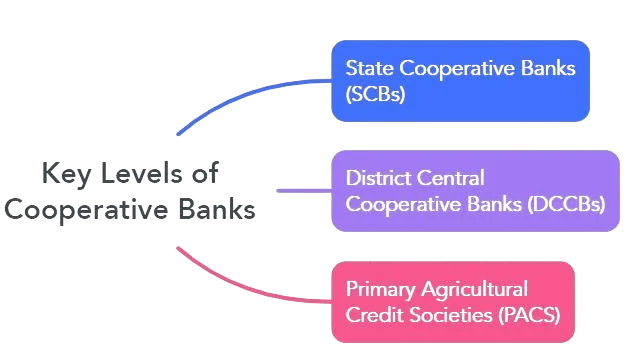
- State Co-operative Banks (SCBs): These banks act as the guiding force at the state level, overseeing and supporting all cooperative banks within their state.
- District Central Co-operative Banks (DCCBs): Operating at the district level, these banks bridge the gap between state-level institutions and local societies, providing essential financial backing to primary cooperative societies.
- Primary Agricultural Credit Societies (PACS): At the heart of this system, PACS work directly with farmers and rural communities, offering essential credit and financial assistance where it’s needed most.
Types of Cooperative Banks
Co-operative banks in India can be categorized into several types based on their operational scope and target clientele:
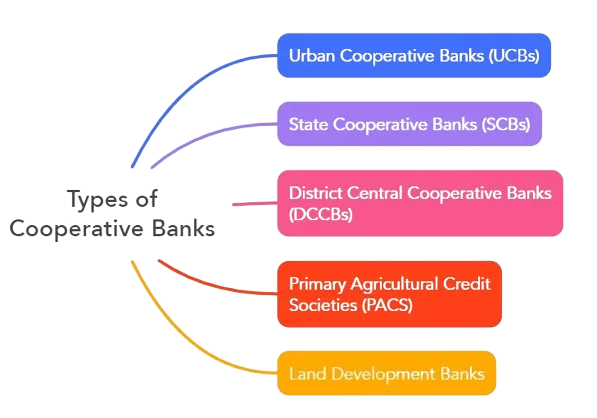
1. Urban Co-operative Banks (UCBs)
Urban Cooperative Banks primarily serve urban and semi-urban areas. They cater to small borrowers and businesses, offering services such as savings accounts, loans, and other financial products. UCBs can be further classified into:
- Scheduled UCBs: These are included in the Second Schedule of the Reserve Bank of India Act, 1934, allowing them to access certain privileges.
- Non-Scheduled UCBs: Not listed under the Second Schedule, these banks operate independently without some regulatory benefits.
2. State Co-operative Banks (SCBs)
SCBs operate at the state level and act as a link between the Reserve Bank of India (RBI) and other cooperative banks within the state. They provide refinancing facilities to DCCBs and PACS.
3. District Central Co-operative Banks (DCCBs)
These banks function at the district level, primarily lending to PACS and supporting agricultural financing in rural areas.
4. Primary Agricultural Credit Societies (PACS)
PACS are grassroots-level cooperative societies that provide credit to farmers for agricultural activities. They play a crucial role in rural finance by facilitating access to credit for agricultural development.
5. Land Development Banks
These specialized institutions focus on providing long-term credit for agricultural development projects. They are divided into primary, state, and central levels.
Significance of Cooperative Banks
Cooperative banks hold significant importance in India’s economy for several reasons:
- Financial Inclusion: They play a vital role in providing financial services to underserved populations, particularly in rural areas where traditional banking services may be limited.
- Support for Agriculture: Given India’s agrarian economy, these banks are crucial for providing credit to farmers for purchasing seeds, fertilizers, and equipment.
- Community Development: By operating on a cooperative model, these banks foster community development through local ownership and participation.
- Employment Generation: Cooperative banks contribute to job creation by supporting small businesses and agricultural enterprises.
Regulatory Framework
The regulation of cooperative banks in India falls under multiple authorities:
- The Reserve Bank of India (RBI) regulates scheduled cooperative banks.
- The National Bank for Agriculture and Rural Development (NABARD) oversees land development banks.
- State governments regulate non-scheduled cooperative banks through respective state laws.
Differences Between Cooperative Banks and Commercial Banks
While both cooperative banks and commercial banks offer similar financial services, there are key differences between them:
| Feature | Cooperative Banks | Commercial Banks |
| Ownership | Owned by members who are also customers | Owned by shareholders; profit-driven |
| Profit Motive | Operate on “no profit, no loss” principle | Aim to maximize profits |
| Target Audience | Focus on underserved communities | Serve a wide range of customers |
| Regulatory Framework | Governed by specific cooperative laws | Governed by Banking Regulations Act |
| Decision-Making | Democratic; members have voting rights | Centralized; decisions made by management |
You may also like to know the difference between public banks and private banks.
Top 10 Cooperative Banks in India
Here’s a detailed look at the top 10 cooperative banks in India, highlighting their unique features and contributions.
1. Saraswat Cooperative Bank
Founded in 1918 and headquartered in Mumbai, Saraswat Cooperative Bank is one of the largest urban co-operative banks in India. It operates across eight states, namely, Maharashtra, Goa, Gujarat, Delhi, Madhya Pradesh, Karnataka, Haryana and Uttar Pradesh. In March 2025, the bank had a total business of Rs. 91,800 crore. It has more than 300 branches and 350+ ATMs.
The bank offers a wide range of services such as retail banking, loans, deposits, and digital banking solutions. In recent years, it has been recognized for its excellent customer service and innovative technological initiatives, solidifying its position as a pioneer in the urban co-operative banking sector in India.
2. Cosmos Co-operative Bank
Cosmos Co-operative Bank, established over a century ago in 1906 and based in Pune, Maharashtra, serves more than 20 lakh customers through its extensive network of branches. The bank is notable for being the first cooperative bank in India to open a currency chest.
It has 183 branches in 7 States, and is known for providing various services including retail banking, loans, deposits, and internet banking. Cosmos Bank has built a reputation for professionalism and ethical banking practices.
3. Bharat Cooperative Bank
Bharat Cooperative Bank, founded in 1978, is one of the leading co-operative banks in India. Headquartered in Mumbai, the bank focuses on retail banking services such as savings accounts, loans, and mobile banking.
The Bharat Cooperative Bank has made significant strides in customer service and technological advancements to enhance user experience. Its commitment to community service has helped it build a loyal customer base over the years.
4. Abhyudaya Cooperative Bank
The Abhyudaya Cooperative Bank was established in 1964 in Mumbai with the motto of “Prosperity through Co-operation”. It has gained recognition for its community-focused banking services aimed at socio-economically weaker sections.
It is a multi-state urban co-operative bank with presence in Maharashtra, Karnataka and Gujarat. It offers a comprehensive range of products including retail banking, loans, deposits, and digital banking solutions across Maharashtra and other states like Gujarat and Karnataka.
5. Thane Janata Sahakari Bank (TJSB)
Founded in 1972 in Thane, Maharashtra, TJSB Cooperative Bank has evolved into a leading multi-state scheduled cooperative bank with a robust network of branches. The bank provides various services such as retail banking, UPI transactions, loans, and deposits.
TJSB is known for its customer-centric approach and innovative financial products. At the 16th Annual IBA’s Banking Technology Awards (2021), TJSB was awarded with the Runner-Up Prize for ‘Best Technology Bank of the Year’ amongst co-operative banks.
6. Kalupur Commercial Cooperative Bank
Based in Ahmedabad, Gujarat, Kalupur Commercial Cooperative Bank has been operational since 1970. It is regarded as one of the leading co-operative banks in the state of Gujarat.
It offers traditional banking services like loans and deposits alongside modern digital banking solutions such as internet and mobile banking. The bank is recognized for its exceptional customer service and commitment to community development.
7. Shamrao Vithal Cooperative Bank (SVC)
The Shamrao Vithal Cooperative Bank, established in 1906 in Mumbai, is one of the oldest cooperative banks in India. It is a multi-state scheduled bank with a presence across numerous states like Maharashtra, Karnataka, Tamil Nadu, Telangana, Delhi, Haryana, Goa, Gujarat and Madhya Pradesh. Currently, it has more than 200 branches.
SVC offers comprehensive banking solutions including retail banking and digital services. The bank has received accolades for its innovative products aimed at enhancing customer satisfaction.
8. Janata Sahakari Bank Ltd
The Janata Sahakari Bank Ltd was founded in 1949. It is located in Pune, Maharashtra. This bank provides a wide array of financial services including retail banking and core banking technology solutions. It focuses on community welfare by offering accessible financial products tailored to the needs of local residents.
The goal of Janata Sahakari Bank has always been to help the economically weaker section of the society. It has carved a place as a bank of masses and not only for classes. In 2012, the bank got status of Multi-State Scheduled Bank. Currently, the Janata Sahakari Bank has a wide network of branches across Maharashtra and also in Gujarat.
9. The Punjab State Cooperative Bank
The Punjab State Cooperative Bank was established in 1949. It is headquartered in Chandigarh, and specializes in agricultural banking and rural finance. It serves as the apex co-operative bank in Punjab.
The Punjab Cooperative Bank plays a crucial role in supporting farmers through various loan schemes and deposit products aimed at enhancing agricultural productivity across Punjab. In 2023, it launched a mobile banking application to enhance customer access to service.
10. NKGSB Cooperative Bank Ltd
Founded by the Konkan Saraswat community in 1917, NKGSB Cooperative Bank Ltd is based in Mumbai. This bank is one of the top 10 cooperative banks in Maharashtra, and has been serving customers for more than 100 years.
It offers a range of services including retail banking, loans, deposits, and digital banking options tailored to meet the needs of its diverse clientele. Currently, the NKGSB Cooperative Bank is operational in the States of Maharashtra, Karnataka, Goa, Gujarat, Madhya Pradesh and Union territories.
The above-mentioned banks not only provide essential financial services but also contribute significantly to the socio-economic development of their respective communities through various initiatives aimed at empowering individuals and businesses alike.
As informed by RBI and NABARD, the number of cooperative banks in India as on 31.03.2025, is as follows:
- State Cooperative Banks (StCBs) – 34
- District Central Cooperative Banks (DCCBs) – 352
- Urban Cooperative Banks (UCBs) – 1457
Who regulates cooperative banks in India?
Co-operative banks in India are regulated by various authorities depending on their classification:
- Scheduled co-operative banks are regulated by the Reserve Bank of India (RBI).
- Land development banks fall under the purview of NABARD.
- Non-scheduled cooperative banks are regulated by state governments through respective state laws.
Conclusion
Co-operative banks play an essential role in India’s economy by promoting financial inclusion, supporting agriculture, and fostering community development. Their unique structure allows them to cater specifically to the needs of their members while operating under a framework that prioritizes mutual benefit over profit maximization. As they continue to evolve within India’s dynamic financial landscape, their contributions remain invaluable for sustainable economic growth and social welfare.
This detailed exploration provides insights into how co-operative banks function within India’s broader banking system while highlighting their significance in fostering inclusive growth across diverse communities.




Great insights on the cooperative banking sector in India! I’m particularly interested in how these banks are adapting to technological advancements. It would be helpful to see more on their digital initiatives in future posts. Thanks for sharing!
Great insights on the top cooperative banks in India! It’s exciting to see how these institutions are evolving and contributing to the financial landscape. I’m particularly interested in how they are adapting to digital banking trends. Thanks for the detailed analysis!