support@registrationkraft.com


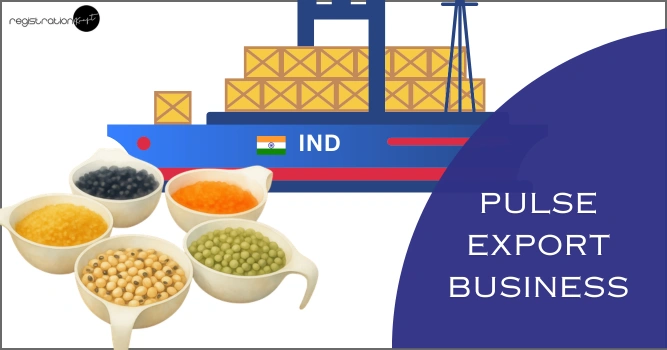

India is the largest producer of pulses, accounting for nearly a quarter of the global pulse production. It is also one of the largest exporters of pulses. If you are interested in finding out how to export pulses from India, then check out this blog post! Here, we shall explain all the licenses and registrations required to start a pulse export business in India.
Why Start a Pulse Export Business?
Pulses are a high source of protein, fiber and micronutrients. They are a vital part of a healthy diet, especially for individuals who do not consume meat (like vegetarians, vegans and eggitarians). That said, many individuals across different regions in the world mix pulses in their meat dishes for even more protein rich meals.
For instance, Lentil Yahniya stew incorporates pulses and meat. Hummus Kawarma is a modern or regional variation where traditional hummus made from chickpeas is topped with spiced minced lamb or beef. Since many countries across the world do not produce enough pulses, they end up importing pulses from other countries.
India, being one of the largest pulse producers, can help such countries meet the pulse demands. Basically, entering the pulse export business can be a profitable venture for you, and you can play a crucial role in global nutrition as well as sustainable food systems.
List of Pulses Exported from India
Some popular pulses exported from India include the following :-

- Chickpeas (Chana)
- Lentils (Masoor Dal)
- Pigeon Peas (Toor Dal/Arhar)
- Black Gram (Urad Dal)
- Green Gram (Moong Dal)
These pulses are sold as whole grains or split (dal) to various markets across the world like the US, Bangladesh, China, Nepal, Türkiye and UAE.
How to Start a Pulse Export Business: Licenses & Registrations
Now, let’s discuss the licenses and registrations required to export pulses from India.
Business Registration
Before you start pulse export business activities, you need to first decide the structure for your business. You have many options to choose from as there are various business structures that can be incorporated in India. If you want to operate the business as a sole owner, you can choose sole proprietorship. In case you want to operate the business with one partner or multiple partners, you can opt for a partnership firm. With these structures, you can save up money associated with the business registration costs as they do not mandate registration (but still can be registered for better legal recognition).
However, both these structures lack legal separation from its owner. Therefore, in case of debt or losses, the owner’s personal assets will be at risk. If you want to operate the business solely but want limited liability protection, you can choose the one person company structure. In this company, the company is a separate legal entity from its owner. Also, the company’s owner can also be the company’s director. A separate individual isn’t required to be appointed as a director.
If you want to operate the business with a partner or numerous partners along with limited liability protection, you can choose to register a limited liability partnership. The OPC and LLP are subject to less restrictions as compared to other models like Private Limited Company. However, Private Limited Company and Public Limited Company are often cited as the most credible business structures. They allow for easier access to funding.
By establishing a public limited company, the general public can invest in your company via stock exchanges (that is, if you launch an IPO). In the case of a private limited company, individuals can invest in your business via private channels. However, both pvt and public ltd companies are subject to more restrictions and compliance burdens as compared to most other structures. If you need help in deciding the right structure, you can connect with our company registration consultants at Registrationkraft.
After you decide the structure, you need to register your business. The business registration process varies depending on the structure you opt for. In case of the limited liability partnership firm, FiLLiP (Form for Incorporation of Limited Liability Partnership) needs to be filed with the Registrar of Companies. However, in case of pvt ltd co, SPICe+ (Simplified Proforma for Incorporating Company electronically Plus) form needs to be filed with the Registrar.
Import Export Code Registration
Import Export Code (IEC) Registration is a mandatory registration process that a business cannot skip if it wants to engage in import or export activities. As per the Foreign Trade Development and Registration Act 1992, IEC is a mandatory requirement for any Indian business involved in global trade.
An IEC is an alphanumeric code containing 10 unique digits. The Directorate General of Foreign Trade is responsible for issuing IEC to the import and export businesses in India. To apply for IEC, the process is online.
It must be completed by visiting the official portal of the Directorate General of Foreign Trade. The good thing about IEC is that it doesn’t require any renewal. However, it requires updation every year to maintain its active status.
FSSAI License
You need to obtain an FSSAI License for your pulse export business. This license is mandatory for all businesses that are engaged in export of food items to other countries. The FSSAI license is issued by the Food Safety and Standards Authority of India, in accordance with the Food Safety and Standards Act 2006.

By obtaining this license, you ensure that your pulses comply with the necessary safety and quality standards required for international trade. There are different kinds of FSSAI licenses :- FSSAI basic license, FSSAI state license and FSSAI central license. The exact FSSAI license a business needs to obtain depends on the annual turnover and scale of operation.
However, in case of pulse export business, central FSSAI license is mandatory for the exporter irrespective of annual business turnover. This is because food products being exported fall under food business activities that require central license rather than just a state license.
APEDA Registration
Agricultural and Processed Food Products Export Development Authority, abbreviated as APEDA, is responsible for export promotion and development of a variety of items included under its list of scheduled products under the APEDA Act 1985. To export any scheduled product, APEDA registration is required.

Pulses are a part of APEDA’s list of scheduled products. Therefore, it is mandatory for pulse exporting businesses to secure APEDA registration by filing an application with the Agricultural and Processed Food Products Export Development Authority.
The process for registering with APEDA is an online process. The application for APEDA registration needs to be filed on the same portal meant for IEC registration, i.e., the official portal of Directorate General of Foreign Trade.
Phytosanitary Certificate
A Phytosanitary Certificate is one of the key requirements for plant and plant product exporters. The plant quarantine station, under the Directorate of Plant Protection, Quarantine & Storage (DPPQS), Ministry of Agriculture, issues this certificate.
The phytosanitary certificate must be obtained by a business to certify the consignment is free from pests and diseases. It is essential for meeting the importing country’s plant health requirements.
GST Registration
GST registration is a mandatory requirement for businesses whose annual turnover exceeds Rs. 40 lakhs for goods or Rs. 20 lakhs for services. However, in case of businesses engaged in export activities, GST registration is mandatory regardless of the annual turnover. Therefore, it is important that you register your pulse export business under the GST system.
To register for GST, you need to complete the process online via the official GST portal. After successful registration, you can download the GST registration certificate, containing a goods and services tax identification number (GSTIN) that is unique to each business.
The GSTIN serves as the business’s official identity in the GST system. It is noteworthy to mention that GST registration certificate does not have an expiry date and thus does not require renewal.
Related Post: ROI Calculation for an FMCG Distributor
Conclusion
India is the largest producer of pulses in the world. It is also one of the world’s largest exporters of pulses. By starting a pulse export business, you can help to meet the global demand for pulses and help individuals across the world meet their nutritional needs. To start this business, you require several licenses and registrations like FSSAI license, APEDA registration, GST registration, Import Export Code registration, Business registration, etc. If you need assistance in applying for these legal documents, you can connect with our professional consultants at Registrationwala!